
Why Play Therapy Matters: How Children Heal Through Play
Picture your child after a hard day. You ask what’s wrong, and you get a shrug, a quiet “nothing,” or maybe tears with no explanation. It’s not necessarily that they don’t want to tell you. Often, children simply don’t have the words to explain what they’re feeling.
Big emotions can be difficult to put into sentences, especially for young children. But give that same child a basket of toys, art supplies, puppets, or a sandbox, and something can shift. Through play, children often begin to express what words cannot.
That’s at the heart of play therapy for children.
What Is Play Therapy for Children?
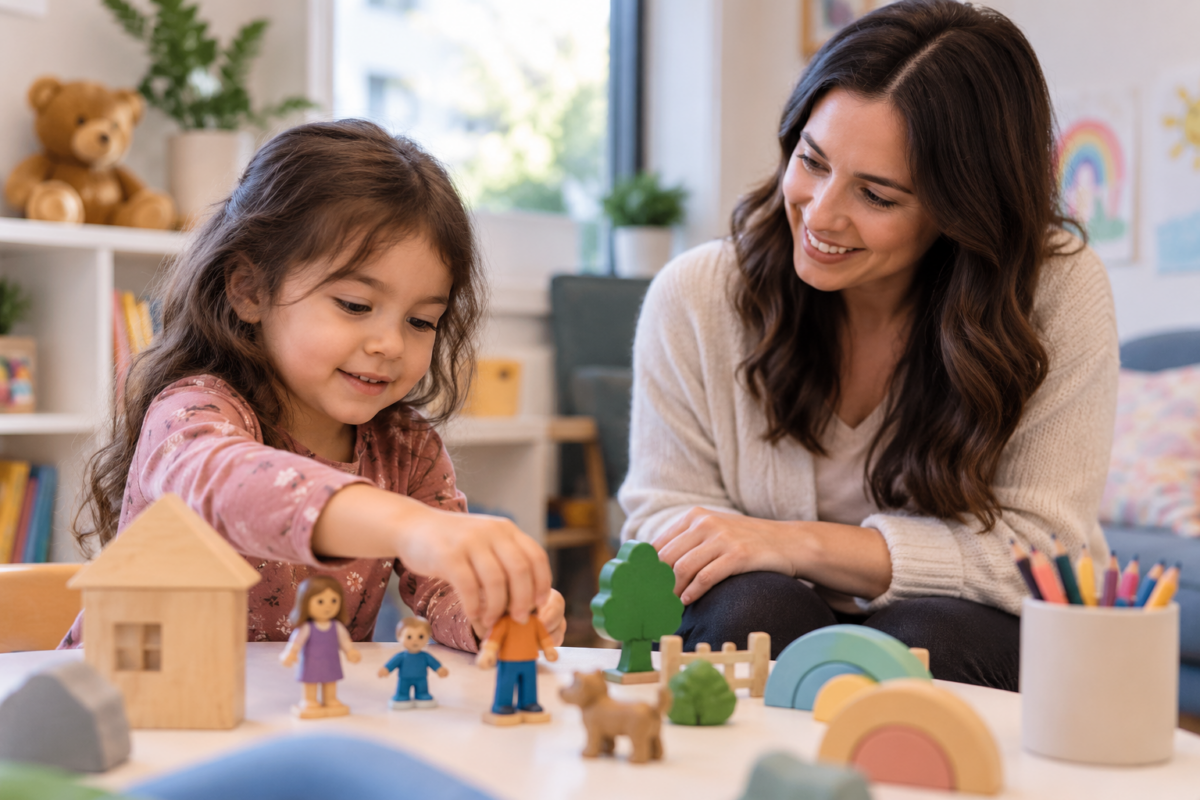
Play therapy is a therapeutic approach that helps children explore feelings, experiences, and challenges through play. Instead of expecting a child to sit down and explain their worries, a trained therapist may use toys, art, sand, puppets, games, and imaginative play to help the child communicate.
In this setting, play becomes a form of language.
Play has long been recognized as an important part of childhood development. Modern research continues to demonstrate how play supports cognitive, emotional, and social development (Chauhan et al., 2024).
There are several approaches to play therapy. One of the most common is child-centred play therapy, where the child takes the lead while the therapist provides a supportive and accepting environment.
In other situations, a therapist may use specific activities, toys, stories, or puppets to help a child explore difficult emotions or gradually make sense of a stressful or frightening experience.
Why Does Play Therapy Work?
Play is much more than a way to keep children occupied. It plays an important role in how children learn, develop, communicate, and process their experiences.
When children play, they bring together what they see, feel, imagine, and experience. This process can help strengthen important cognitive, emotional, and social skills (Chauhan et al., 2024).
Because play involves both thinking and feeling, it can also give children opportunities to recognize emotions and practise managing them in a safe environment.
For children who have experienced something difficult or frightening, talking directly about the experience may feel overwhelming. Some children may not yet have the language or developmental ability to describe what happened or how it made them feel.
Play therapy gives children another way to communicate.
Through toys and imagination, children may be able to explore difficult feelings from a safer emotional distance. This can help them process experiences at their own pace without feeling pressured to explain everything verbally (CCFAM, 2026).
Benefits of Play Therapy for Children
Research into play therapy has produced encouraging findings. A large meta-analysis examining 93 studies found positive treatment outcomes for children who participated in play therapy compared with children who did not receive treatment (Bratton et al., 2005).
Depending on the child and their individual needs, play therapy may help support children experiencing:
- Anxiety, worry, or fears
- Sadness and difficult emotions
- Behavioural challenges
- Family changes or separation
- Stressful or frightening experiences
- Difficulty making or maintaining friendships
- Problems expressing emotions
- Challenges with self-control
- Difficulty focusing or staying on task
- Low confidence or difficulty coping with challenges
Play can also help children develop skills related to self-control, attention, and problem-solving (Rice, 2016). Play-based programs have also been studied for their potential to support resilience, emotional regulation, and executive functioning (Yildiz & Guler Yildiz, 2025).
Every child is different, so the goals and outcomes of therapy will vary. A qualified therapist can help determine the most appropriate approach based on a child’s age, experiences, needs, and circumstances.
Play Helps Children Express Difficult Emotions
Adults often rely on conversation to work through problems. Children may communicate very differently.
A child might create a story with dolls, repeatedly build and knock down a tower, draw a picture, create a scene in a sandbox, or act out situations with puppets.
To an adult, it may look like ordinary play. To a trained play therapist, however, these activities may provide opportunities to better understand the child’s emotions, concerns, and experiences.
Most importantly, the child has a space where they can express themselves without being pressured to find the “right” words.
Why Play Is Important for Healthy Child Development
Play isn’t simply a break from learning and growing. Play is one of the ways children learn and grow.
When children play, they develop imagination, creativity, social skills, emotional awareness, and problem-solving abilities (Ginsburg, 2007).
Play also contributes to the development of executive function—the mental skills children use to pay attention, remember instructions, manage behaviour, work toward goals, and tune out distractions (Yogman et al., 2018).
It also provides opportunities for children to practise everyday social skills.
Through play, children can learn how to:
- Share and take turns
- Work through disagreements
- Solve problems
- Understand another person’s perspective
- Express feelings
- Cooperate with others
- Develop confidence
- Adapt when things don’t go as planned
These skills can support children at home, at school, and in their relationships with others.
How Play Therapy Supports Emotional Development
One reason play therapy for children can feel so natural is that it works within a familiar part of childhood.
Rather than asking children to communicate entirely like adults, play therapy meets them at their developmental level. A therapist can use the natural process of play to help a child explore emotions while also supporting healthy social and emotional development.
Each session can provide a safe environment where children have opportunities to build confidence, practise coping skills, and work through difficult experiences.
The Parent’s Role in Play Therapy
Parents and caregivers can also play an important role in supporting a child’s progress.
Research suggests that parental involvement may strengthen the benefits of play therapy in some circumstances (Bratton et al., 2005).
A therapist may teach parents simple ways to support healthy play and communication at home. This doesn’t mean parents need to become therapists. Instead, it can help bring some of the warmth, connection, acceptance, and emotional safety encouraged in therapy into everyday family life.
Small moments of undistracted play can give children valuable opportunities to connect with their parents and caregivers.
When Should You Consider Play Therapy for Your Child?
Parents sometimes wonder whether their child’s struggles are “serious enough” to seek professional support.
If your child is having ongoing difficulty with emotions, behaviour, anxiety, relationships, family changes, stressful experiences, or other challenges that affect daily life, speaking with a qualified child and youth counsellor can be a helpful first step.
You don’t need to wait until a child can perfectly explain what they’re feeling.
Play therapy meets children where they are, using a form of communication that comes naturally to them.
It can give children a supportive space to explore difficult feelings, strengthen coping skills, and process experiences at their own pace.
For children, play isn’t just entertainment. It can be a powerful way to communicate, connect, learn, and heal.
References
Bratton, S. C., Ray, D., Rhine, T., & Jones, L. (2005). The efficacy of play therapy with children: A meta-analytic review of treatment outcomes. Professional Psychology: Research and Practice, 36(4), 376–390. https://doi.org/10.1037/0735-7028.36.4.376
CCFAM. (2026). The science behind play therapy for kids. https://ccfam.com/the-science-behind-play-therapy-for-kids/
Chauhan, N., Sachdeva, D., Malhotra, S., & Gupta, N. (2024). Play therapy: An analytical mode of therapy in children. Journal of Psychiatry Spectrum, 3(2). https://doi.org/10.1177/09731342241238524
Ginsburg, K. R. (2007). The importance of play in promoting healthy child development and maintaining strong parent-child bonds. Pediatrics, 119(1), 182–191. https://doi.org/10.1542/peds.2006-2697
Rice, T. (2016). Commentary: How child’s play impacts executive function-related behaviors. Frontiers in Psychology, 7, 968. https://doi.org/10.3389/fpsyg.2016.00968
Yildiz, S., & Guler Yildiz, T. (2025). Examination of the effects of a play-based mindfulness training program on resilience, emotion regulation skills, and executive functions of preschool children. International Journal of Environmental Research and Public Health.
Yogman, M., Garner, A., Hutchinson, J., Hirsh-Pasek, K., & Golinkoff, R. M. (2018). The power of play: A pediatric role in enhancing development in young children. Pediatrics, 142(3).
Guest Author
Kurina | MPCC-Provisional, CPCA #4343
Child & Youth Counsellor
Healing Hearts Therapy
Delta, BC
Ph: (604) 594-7884
www.Healingheartstherapyservices.ca